Prophecy

Excerpts and selected readings from Zohara’s new book
Kabbalistic Teachings of the Female Prophets
The Seven Holy Women of Israel
Inner Traditions Intl, Spring/Summer 2008
Prophecy and the Prophetesses: The History of Prophecy in Judaism

The lives and teachings of the women of prophecy, the seven Prophetesses of Israel, are rooted in the art and practice of prophecy itself. According to the classical Jewish writings, prophecy has played an important role in Judaism historically as a tool for divine revelation and communal guidance. A person can experience prophecy as a result of great effort and preparation or by divine selection alone. Prophecy is given to a person or a group of people only if their generation is deserving of such revelation.

While it is traditionally said that prophecy left the Jewish people with the destruction of the Second Temple in 70 CE, texts attest to the fact that certain levels of prophecy, such as the Ruach HaKodesh, a gift of the Holy Spirit, “… is attainable by any person, at any time or place as long as the person makes himself worthy of it.” Many sources suggest that prophecy was a counterbalance to idolatry and that when idolatry ceased, so too did prophecy.

Another opinion is that while prophecy of the level during which the Temple stood ceased after 70 CE, prophecy has never left the Jewish people. “Any Torah leader whose works have been accepted by all of Israel, is assumed to have been divinely guided.” Prophetic insight, demonstrated through the intellect and soul of a scholar or person living a devoted Torah-directed life continues. According to R. Moses Ben Maimon, (Maimonides or The Rambam, 1135-1204 CE), with the exception of Isaiah, every Jewish Prophet in the Bible received his gift through his predecessors, and are part of a long unbroken chain of prophecy.
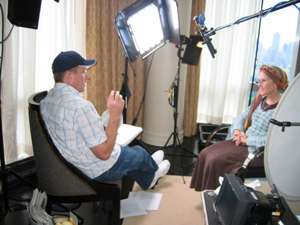
Zohara being interviewed by Guy Richie, 2006

In his The Guide of the Perplexed, the Rambam explains that God grants the gift of prophecy only for the sake of his people. Even if an individual is worthy, prophecy will not be obtained unless his or her generation is also worthy. The Rambam writes that a Prophet must obtain his first prophecy in Israel before obtaining a vision in other lands, and then, only if it is absolutely necessary for the sake of Israel. Three of the seven Prophetesses: Sarah, Miriam and Esther all received their prophecies outside the land of Eretz Yisroel for the sake of the entire People of the Book.


God, Prophecy and Torah

The body and prophecy are inseparable just as the soul of the Prophet and closeness to the Creator, are fashioned in partnership. Prophecy is intended for correcting of behavior, prediction of the future, or to avert danger from a threat to national defense or natural disasters. Study of Torah (the word of God), and practicing the art of prayer, the service of the heart, conditions the body and soul to being a ‘God-attuned’ vessel through which prophecy can occur.

The teachings of the Chassidic tradition (Chassidut) reveal that God, being a total unity has no needs, but as a form of giving, desires to see man’s pleasure in becoming God-like. Self-refinement and right action are the hallmarks of the journey. The Torah instructs us about the creation of humankind on the sixth day of God’s creation of the world. Our refinement and way to perfection is through closeness with the Creator, which prophecies highlight.

“Every Prophet has a kind of speech peculiar to him,” reveals the Rambam. It is “the language of that individual’s, which the Prophetic revelation peculiar to him causes him to speak to those who understand him.” As expressions of the outcome of living a Torah-centered life, the Prophets and Prophetesses are holy figures proving that prophecy is the outcome of God’s Torah. Sometimes the Prophets are not believed and their prophecies are ignored. Their own courage becomes the foundation upon which their prophecy remains intact and its record preserved.

The Torah (Teaching) is the Book

Torah, from the root “yoreh”, to teach, is the Hebrew word representing “the Book” in the expression “the People of the Book’. Torah is also referred to as “the law”. Torah can stand for the first five books of the Old Testament, or the Five Books of Moses, the Pentateuch, or all of the Old Testament Bible made up of twenty-four books. The word Torah refers to the written and oral teachings of Judaism that were handed down in an unbroken tradition. “Moses received the Torah from [God who revealed himself at Mount] Sinai and conveyed it to Joshua; Joshua [conveyed it] to the Elders; the Elders [conveyed it] to the Prophets; and the Prophets to the Men of the Great Assembly. They said three things: “Be deliberate in judgment; develop many disciples; and make a protective fence for the Torah.”

The human is given instructions in Torah for becoming holy. Chassidut teaches that Torah is the blueprint for creation that the Creator authored prior to creating the world and is a guide for humankind’s refinement. This divine map is contained in Torah and understood through the Jewish spiritual science and art of Kabbalah. From the three-letter root (KBL), (Kof, Beit Lamed), Kabbalah means a received tradition. The rigorous self-discipline it describes for the individual and the community who receives it, can lead to prophecy as the natural outcome of attendance to God, love of others and service in the world in a holy and selfless fashion.

Prophetic visions generally occur in fields and woods, by rivers and mountains, in places uncontaminated by the general population. Prophecy is how the Divine Will and presence are made known to the individual and the community. It serves as a way for the Creator to instruct and guide the created, to come closer to Him, discerning the relationships between the seen and unseen, the physical and the immaterial. Prophecy occurs in different forms and in different intensities. Ultimately, this “Holy Speaking” is to unite humanity with God. Echad, the Hebrew word for oneness, is the process and the outcome of prophecy.

Prophecy: Supreme Language of the Soul

Prophecy distinguishes itself from all other arts and intuitive talents. It delegates to the Prophet an unequalled status among their peers as the Creator’s representative. They are found to be of good character, wise judgment, merciful hearts, righteous and diligent in study, teaching, and practice of their faith.

Prophecy as the supreme language of the soul, is a vehicle by which the Creator instructs His people. Those gifted with Prophetic talent are by their very presence, performing the role of teacher and guide to the community, no matter how quiet or robust their public standing.

The Rambam explains that a Prophet’s unusual capacity to hear the word of God through the various faculties of perception, results from the combination of a strong intellect and a vigorous imagination. Prophecy is the overflow of the presence of the Holy One to that individual, group or nation. Required are both the faculty of courage and an aptitude for divination.


Kabbalah – The Creator’s Blue Print

The Torah is the Creator’s blueprint for creation; Kabbalah’s Etz Chayim its decoding map for understanding the secrets of the written and oral teaching of the Torah. The map represents Adam Kadmon, the primordial man from which all of the worlds originate. “This Adam Kadmon acts as a filter through which the light of the Infinite is emanated,” says the Ari (R. Issac Luria), “especially from his eyes, ears, nose, and mouth, representing the human organs of vision, hearing, smell, and speech.” Adam Kadmon was how the Creator engendered the four worlds by which the universe is structured: emanation (Atzilut), creation (Beriyah), formation (Yetzirah) and action (Asiyah). Our bodies, souls and all of creation function in these four dimensions.

Humanity, being made in God’s image, explains why Kabbalah’s holy map is a sacred tool for humanity’s development and refinement. Each of us reflects this sacred pattern in our spiritual and material composition. Using Kabbalah for self-refinement can lead to Prophetic union with God and his Holy Spirit, making one’s life meaningful, joyous and full of peace.

Breaking of the Vessels and Raising the Fallen Sparks

Prior to settling on the Etz Chayim as a model for the gradual descent of the light from God, the Creator utilized a variety of methods for distributing his limitless light to the world. The Creator (HaShem) emanated his light (orot) directly into vessels (kelim) below. Each successive vessel was smaller than the one above it. Unable to hold all of the emanations from preceeding vessels, each Sefirah broke in succession. This resulted in what is called in Kabbalah “the breaking of the vessels” (Shevirat HaKelim), producing the “fallen sparks” which are encased in the (Kelipot), the shells of evil. It is from these Kelipot or shells that all evil inclinations are derived. The Creator’s purposeful event (of Shevirat HaKelim) created the opportunity for Humanity to utilize our God given free will for the repair of all sin. This is what is meant by, ‘choosing good.’

Choosing Good Over Evil

When we do what is most beneficial according to the divine laws we are given, we elevate the sparks in that situation, person, place or idea. Each of our spiritual missions includes elevating these fallen sparks of holiness wherever they are found. “Man was given the task of rectifying all creation in maintaining all things in the state
desired by God, man is serving God and doing His work. This is accomplished through man’s actions based on the Torah and commandments that he was given. All of this however, is based on the fact that man is God’s servant, and was therefore given the task of rectifying all creation. It is for this reason alone that his deeds can have such an effect and he can thus actually accomplish this. The fact that man has this responsibility is called God’s yoke…” or the yoke of Torah.

The 613 divine commandments, the good deeds and blessings that accompany them, as well as actions we are to restrain from doing, rectifies the light encased in the ‘Kelipot’ or shells of evil in the world, elevating them back to the Creator transformed. We live in a world of matter and spirit. HaShem’s spirit vivifies matter, materializing spirit so to speak, and human beings, birthed into the world of matter, elevate the material realm by spiritualizing it. It is as though each person acts as an alchemical helper, having the potential to refine everything we come into rapport with, and it is through this that even evil is transformed into good. The Lurianic (Rabbi Issac Luria’s) frame of reference tells a story of the Creation of humankind, its fall and ultimate redemption. The Seven Prophetesses of Israel are a proving of his holy insights.

Kabbalah tells this Lurianic story of creation as a willed contraction by the Creator, called a Tzimtzum, and the resulting single ray of emanation this contraction produced, which took the form of the ten Sefirot. It is from the ten Sefirot that Adam Kadmon (the primordial man) was made, according to the Ari, “who is the sole conduit and filter through which energy flows from the Infinite into the finite worlds that are destined to be created in the midst of the void.” The Ramchal explains what this book posits as well, that all of this work (avodah) of self refinement leads to elevating the body itself. The body participates in the soul’s eternal glory, by choosing good ‘in this world’ (Olam HaZeh) which will be elevated to a status of immortality at resurrection. The ultimate reward for this accomplishment, of control over one’s will and desires is in the World to Come, (Olam HaBa). Torah and Kabbalah give us the tools for this ultimate purpose of perfection. All of Lurianic Kabbalah stems from this foundation.

D. Menzi, Z.Padeh, The Tree of Life. Introduction XXIV.
HaShem is a term used in place of the word God, and literally means ‘the name’ referring to the unknown and unpronounceable name of the Creator.
For a more thorough study of the subject read, Rabbi Schneur Zalman of Liadi, Tanya (Likutei Amarim), (Brooklyn, NY.: Kehot Publication Society, 1993.) Chapter 10.
R.C. Luzzatto, (translator R.Aryeh Kaplan) Derech HaShem, The Way of God. (Jerusalem, NY.: Feldheim Publishers, 1983/5744), 297.
D.Menzi and Z. Padeh, The Tree of Life, xxxviii
Ramchal (R.C. Luzzatto,) Derech HaShem, 391-397.

Excerpted from Kabbalistic Teachings of the Female Prophets
The Seven Holy Women of Ancient Israel

by J.Zohara M. Hieronimus
Inner Traditions, 2008

Moses and Torah

Mt. Sinai– Communal Receiving of “The Book”

At the receiving of Torah all of those present reached a state of Prophetic consciousness, hearing the same words uttered by the Creator through Moses, the greatest Prophet of all. While it is true that Moses heard things others did not, they all heard the word of God revealed through Moses simultaneously. Furthermore, it is said that all present had no regard for themselves but only for each other. Their level of experiencing themselves as one body, as one people, united in the experience of being in the presence of God, has been the testimony of the covenant between the Jewish people and God ever since. The Torah received then is the same Torah studied every day of every year by the living community of this People of the Book.

Moses – The Greatest Prophet Who Ever Was, Is or Will Be
Tradition teaches us that Moses was unlike any other Prophet. “God spoke to Moses face to face, as a man speaks to his friend.” (Exodus 33:11) “Unlike other Prophets, Moses was always in a potential state of prophecy, he could therefore receive God’s revelation at will.” “When Moses went into the Tent of Meeting (Ohel Moed), he heard the Voice speaking to him.” (Numbers 7:89). When asked an opinion, Moses was able to answer, “Stand by, and let me hear what instructions God gives regarding you.”(Numbers 8:9). Moses was able to receive revelation from God at any time and in any place.”

How “The Book” Was Written
As it was through Moses that Torah was given, it is interesting to find out how the People of the Book say the Torah was recorded. A variety of classical Talmudic and Kabbalistic sources describe the process.

“God would dictate each passage of the Torah to Moses and Moses would repeat it out loud. He would then write it down. God would dictate a paragraph to Moses, and then give him a break in order to consider it. These breaks are preserved in the Torah in the form of spacing, dividing the text into paragraphs (Parshiot). Moses would transcribe each of these portions as a small scroll. Shortly before his death, he combined all portions to form the Torah that we have today. According to another opinion, with the exception of certain portions that were needed earlier, the entire Torah was preserved orally until just before Moses’ death when he wrote it all down at once.”

Another point of view is “the entire Torah was given to Moses during two intervals, the first part was given during the year after the Exodus. The rest was given shortly before Israel crossed the Jordon at the end of the forty years in the desert. Between these two periods, there was a hiatus of 38 years, during which no portion of the Torah was given.”

It is also said that before he died, Moses wrote by hand, thirteen Torah scrolls. Twelve of these were given to the twelve tribes and the thirteenth was hidden inside the Ark of the Covenant. Eventually the Ark was put in the Holy of the Holies of the Temple and only occasionally was the scroll brought out in order to check the accuracy of other scrolls produced. One hopes this holy original scroll is still preserved, hidden since 70 CE, and will be revealed at the arrival of the Moshiach (the Jewish Messiah), the Davidic Prophet King and redeemer who will assist God in bringing world peace.

The Covenant Between God and the People of the Book is Prophecy
Prophecy is predicated on conducting one’s inner and outer life according to very particular guidelines. Being not just for the individual but the world, it confirms the oneness of all creation. The Holy Torah begins with Creation, and ends testifying to
the greatest Prophet whoever was, is, or will be, Moses our Teacher (Moshe Rabeinu). If prophecy is inextricably bound up in Torah, then the Prophet and the art of prophecy can be viewed as the outcome of Creation itself, the potential outcome of all the Holy teachings of Judaism. Following “the Book” can produce the Prophetic experience.

An observant life today is based on the same teachings given to Moses and the Israelites . The same words held holy and unchangeable as the divine word of God, have not been changed nor can they be as the “Thirteen Principles” attest to. Adherence to “the Book” can lead to union with God and the perfection of humanity, the final outcome and purpose of Creation.

Excerpted from Kabbalistic Teachings of the Female Prophets
The Seven Holy Women of Ancient Israel

by J.Zohara M. Hieronimus
Inner Traditions, 2008

Web Statistics Clicky